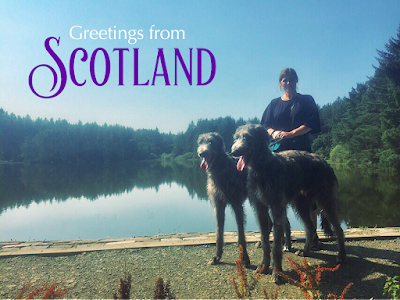
Deerhound

A passionate little site kept by a deerhound dog in Scotland

My Photo
Name: Rogue
Location: Open country, Scotland in a pretty good State

I'm a dog - pretty big in the world of dogs - I don't have to worry about going grey - hey! mountains, rivers, woodland and chasing the Monarch of the Glen across the bonnie purple heather is what I like!

Wednesday, November 25, 2009

Deerhounds Join the Ceilidh!


Come all you deerhounds and human companions who follow our blog and join the world’s biggest ceilidh for St Andrews day. Upload your photographs, then custom select your outfit and get foot tapping and kilt swirling to our auld friend Sandy Brechin.

Click on this link to visit our highland fling or visit scotland.org/ceilidh and use the search window to find Rogue and Rascal. Get yourself started by selecting the join the party button and make sure you have a couple of snaps handy on your computer to upload and edit into the dance - it’s easy.

We look forward to seeing you there.

Tuesday, November 24, 2009

Let the sun shine in

Sunday, November 22, 2009

Rogue, Rascal, the floods and the heart of a deer.


Hey! here in Scotland it’s rain, rain everywhere, and as they say; ‘if it keeps on raining the levee is gonna break’ and our local river is gonna add extra depth to the already flooded fields. It’s not misery for all though, Rogue and Rascal have been enjoying this ‘animals two by two’ event, and had a running riot of a time in the wash. With them creating a playground of this little haunt of our local Roe Deer, I have included a fable looking at it from the deer point of view. Enjoy.

The Deer and his mother A fable (Aphthonius 17).

A deer was being lectured by his mother, “Why do you act this way my child? You have been naturally endowed with horns, and are powerfully built, so I cannot understand why you run away at the approach of the hounds. That is what the mother said. Then when she heard the sound of the hunting dogs in the distance, she again urged her child to stand firm while she herself took of at a run.

It is easy to advise action which cannot be carried out.

Did you know - in Ancient Greece the deer was perceived as the proverbial coward (e.g. Homer, Iliad, Achiles denounces Agememnon for having ‘the Heart of a deer’), but for a deer, when you are pursued by a brace of hungry hounds - flight is no doubt the better option than to stand fast, I’m sure.

Monday, November 09, 2009

Bob Dylan and Deerhounds ?


Just when you thought that Bob Dylan was the poetic folk genius and that A Hard Rain‘s A Gonna Fall was one of the original all time American classics.

Jings! It turns oot to be culled from a Scottish Border tale, post-hunt, with deerhounds & hawk and all, and featuring a dastardly poisoning. All this from a song entitled Lord Randall.

The lyric is believed to be about Thomas Randolph 1st Earl of Moray, Nephew to Robert the Bruce and a signee to the Declaration of Arbroath. He died of a sudden illness at Musselburgh in 1332, which was thought to have been poisoning due to circumstances and the fact that he was on his way to do battle with Edward Balliol at the time.

If you would like to purchase a recorded rendition of Lord Randall, the Scottish tradditional folk piece - follow this link to the Smithsonian Folkways and purchase the CD, MP3 or Cassette and enjoy . . .

Lord Randall

"O where ha you been, Lord Randal, my son?
And where ha you been, my handsome young man?"
"I ha been at the greenwood; mother, mak my bed soon,
For I'm wearied wi hunting, and fain wad lie down."

"An wha met ye there, Lord Randal, my son?
And wha met ye there, my handsome young man?"
"O I met wi my true-love; mother, mak my bed soon,
For I'm wearied wi huntin, and fain wad lie down."

"And what did she give you, Lord Randal, My son?
And wha did she give you, my handsome young man?"
"Eels fried in a pan; mother, mak my bed soon,
For I'm wearied wi huntin, and fein wad lie down."

"And what gat your leavins, Lord Randal my son?
And wha gat your leavins, my handsome young man?"
"My hawks and my hounds; mother, mak my bed soon,
For I'm wearied wi huntin, and fein wad lie down."

"And what becam of them, Lord Randal, my son?
And what becam of them, my handsome young man?
"They stretched their legs out and died; mother mak my bed soon,
For I'm wearied wi huntin, and fain wad lie down."

"O I fear you are poisoned, Lord Randal, my son!
I fear you are poisoned, my handsome young man!"
"O yes, I am poisoned; mother, mak my bed soon,
For I'm sick at the heart, and fain wad lie down."

"What d'ye leave to your mother, Lord Randal, my son?
What d'ye leave to your mother, my handsome young man?"
"Four and twenty milk kye; mother, mak my bed soon,
For I'm sick at the heart, and I fain wad lie down."

"What d'ye leave to your sister, Lord Randal, my son?
What d'ye leave to your sister, my handsome young man?"
"My gold and my silver; mother mak my bed soon,
For I'm sick at the heart, an I fain wad lie down."

"What d'ye leave to your brother, Lord Randal, my son?
What d'ye leave to your brother, my handsome young man?"
"My houses and my lands; mother, mak my bed soon,
For I'm sick at the heart, and I fain wad lie down."

"What d'ye leave to your true-love, Lord Randal, my son?
What d'ye leave to your true-love, my handsome young man?"
"I leave her hell and fire; mother mak my bed soon,
For I'm sick at the heart, and I fain wad lie down."

Saturday, September 26, 2009

The Kennel - from Norman to present day.

Not directly deerhound in content but linked through the tie with hunting hounds comes the origin of the word Kennel.

Where does Kennel originate?

The source is believed to be from the Norman conquerors of England and the Anglo-Saxon’s. These ‘Viking’ Normans took over and constructed their own castles where in, they housed themselves and also allocated an area for their hunting hounds. This area was to be close by the kitchens in many castles. Of course the Lordly Normans would allocate the job of looking after these hounds to the Anglo-Saxon serfs who did not fully understand the language of their new overmasters. And when these new Lords refered to their hounds as ‘La canaile’ (from the Latin diminutive plural caniouli, Little Dogs) the peasant Anglo-Saxons thought it to refer to the doghouse where they and the dogs lived, eventually creating the word Kennel.

Of course the Normans were to eventually penetrate Scotland and its aristocracy as well as be formative in the later clan system (although not by invasion). Many vikings had already invaded and failed to conquer the Picts and Scots of the area.

I’m sure the Normans had an effect on the Scottish Deerhound as they adopted and adapted them for their hunt, particularly in the area we now know as the Borders.

Tuesday, September 22, 2009

Chevy Chace


What happens when you decide to take your hounds a hunting in the Scottish Border Region circa 12th to 17th centuries? Well, from the time of the Reiving and thought to describe the Battle of Otterburn, comes the Ballad - Chevy Chace. Some of the verses may correspond to the battle, but not all. The Battle of Otterburn took place in 1388. At that Battle Henry Percy (Hotspur) was captured, not killed. He was killed in 1403 in an uprising against Henry IV.

According to Francis James Child the folklorist, another possibility for is the border warfare between a Percy and a Douglas in 1435 or 1436. Henry Percy of Northumberland made a raid into Scotland with 4,000 men. He was met by William Douglas, Earl of Angus at Piperden. There were great losses on each side, but the Scots prevailed.

This ballad is a variant of Child Ballad #162 (The Hunting of the Cheviot).

The Hunting of the Cheviot was old and popular as early as the middle of the sixteenth century. It appears in The Complaynt of Scotland (1549). On one published copy of the ballad Rychard Sheale, who described himself as a minstrel living at Tamworth, claims to have written the ballad. Child finds his claim "preposterous in the extreme."

Versions of the ballad were printed repeatedly on broadsides throughout the seventeenth and eighteenth centuries. It was said to be the favorite ballad of the common people. The tune was also used for numerous other ballads.

Of course, what most interests us here is the historic hunting with hounds in the Borders, something that clans were prone to do of the period and in this region, so much so that a whole clan were named for such a reason and feature the hunting hound as their crest - but more of that in a future blog. In the meantime - enjoy this little piece of Deerhound related history and culture.

Thanks to the contemplator - Lesley Nelson-Burns’ Folk Music site for some of the information and inspiration for todays blog - and as per usual - follow the links for related interesting histories.

Chevy Chace

GOD prosper long our noble king,
Our liffes and safetyes all;
A woefull hunting once there did
In Chevy-Chace befall.

To drive the deere with hound and horne,
Erle Percy took his way;
The child may rue that is unborne
The hunting of that day.

The stout Erle of Northumberland
A vow to God did make,
His pleasure in the Scottish woods
Three summers days to take;

The cheefest harts in Chevy-Chace
To kill and beare away:
These tydings to Erle Douglas came,
In Scotland where he lay.

Who sent Erie Percy present word,
He wold prevent his sport;
The English Erle not fearing that,
Did to the woods resort,

With fifteen hundred bow-men bold,
All chosen men of might,
Who knew full well in time of neede
To ayme their shafts arright.

The gallant greyhounds swiftly ran,
To chase the fallow deere;
On Munday they began to hunt,
Ere day-light did appeare;

And long before high noone they had
An hundred fat buckes slaine;
Then having din'd, the drovyers went
To rouze the deare againe.

The bow-men mustered on the hills,
Well able to endure;
Theire backsides all, with speciall care,
That day were guarded sure.

The hounds ran swiftly through the woods,
The nimble deere to take,
That with their cryes the hills and dales
An eccho shrill did make.

Lord Percy to the quarry went,
To view the tender deere;
Quoth he, "Erle Douglas promised
This day to meet me heere;

"But if I thought he wold not come,
Noe longer wold I stay."
With that, a brave younge gentleman
Thus to the Erle did say:

"Loe, yonder doth Erle Douglas come,
His men in armour bright;
Full twenty hundred Scottish speres,
All marching in our sight.

"All men of pleasant Tivydale,
Fast by the river Tweede:"
"O cease your sport," Erle Percy said,
"And take your bowes with speede.

"And now with me, my countrymen,
Your courage forth advance;
For never was there champion yett
In Scotland or in France,

"That ever did on horsebacke come,
But, if my hap it were,
I durst encounter man for man,
With him to breake a spere."

Erle Douglas on his milke-white steede,
Most like a baron bold,
Rode formost of his company,
Whose armour shone like gold.

"Show me," sayd hee, "whose men you bee,
That hunt soe boldly heere,
That, without my consent, doe chase
And kill my fallow-deere."

The man that first did answer make
Was noble Percy hee;
Who sayd, "Wee list not to declare,
Nor shew whose men wee bee.

"Yet will wee spend our deerest blood,
Thy cheefest harts to slay;"
Then Douglas swore a solempne oathe,
And thus in rage did say;

"Ere thus I will out-braved bee,
One of us two shall dye:
I know thee well, an erle thou art;
Lord Percy, soe am I.

"But trust me, Percy, pittye it were,
And great offence, to kill
Any of these our guiltlesse men,
For they have done no ill.

"Let thou and I the battell trye,
And set our men aside."
"Accurst bee he," Erle Percy sayd,
By whome this is denyed."

Then stept a gallant squier forth,
Witherington was his name,
Who said, "I wold not have it told
To Henry our king for shame,

"That ere my captaine fought on foote,
And I stood looking on:
You bee two erles," sayd Witherington,
"And I a squier alone.

"Ile doe the best that doe I may,
While I have power to stand;
While I have power to weeld my sword,
Ile fight with hart and hand."

Our English archers bent their bowes,
Their harts were good and trew;
Att the first flight of arrowes sent,
Full four-score Scots they slew.

[Yet bides Earl Douglas on the bent,
As Chieftain stout and good,
As valiant Captain, all unmov'd
The shock he firmly stood.

His host he parted had in three,
As Leader ware and try'd,
And soon his spearmen on their foes
Bare down on every side.

Throughout the English archery
They dealt full many a wound;
But still our valiant Englishmen
All firmly kept their ground.

And throwing strait their bows away,
They grasp'd their swords so bright:
And now sharp blows, a heavy shower,
On shields and helmets light.]

They clos'd full fast on everye side,
Noe slacknes there was found;
And many a gallant gentleman
Lay gasping on the ground.

O Christ! it was a griefe to see,
And likewise for to heare,
The cries of men lying in their gore,
And scattered here and there.

At last these two stout erles did meet,
Like captaines of great might;
Like lyons wood they layd on lode,
And made a cruell fight.

They fought, untill they both did sweat,
With swords of tempered steele;
Until the blood, like drops of rain,
They trickling downe did feele.

"Yeeld thee, Lord Percy," Douglas sayd
"In faith I will thee bringe,
Where thou shalt high advancèd bee
By James our Scottish king.

"Thy ransom I will freely give,
And thus report of thee,
Thou art the most couragious knight
That ever I did see."

"Noe, Douglas," quoth Erle Percy then,
"Thy proffer I doe scorne
I will not yeelde to any Scott,
That ever yett was borne."

With that, there came an arrow keene
Out of an English bow,
Which struck Erle Douglas to the heart,
A deepe and deadlye blow:

Who never spake more words than these,
"Fight on, my merry men all;
For why, my life is at an end:
Lord Percy sees my fall."

Then leaving liffe, Erle Percy tooke
The dead man by the hand;
And said, "Erle Douglas, for thy life
Wold I had lost my land!

"O Christ! my verry hart doth bleed
With sorrow for thy sake;
For sure, a more renownèd knight
Mischance cold never take."

A knight amongst the Scotts there was,
Which saw Erle Douglas dye,
Who streight in wrath did vow revenge
Upon the Lord Percye;

Sir Hugh Mountgomerye was he call'd,
Who, with a spere most bright,
Well-mounted on a gallant steed,
Ran fiercely through the fight;

And past the English archers all,
Without all dread or feare,
And through Earl Percyes body then
He thrust his hatefull spere

With such a vehement force and might
He did his body gore,
The speare ran through the other side
A large cloth-yard, and more.

So thus did both these nobles dye,
Whose courage none could staine;
An English archer then perceiv'd
The noble erle was slaine.

He had a bow bent in his hand,
Made of a trusty tree;
An arrow of a cloth-yard long
Up to the head drew hee.

Against Sir Hugh Mountgomerye,
So right the shaft he sett,
The grey goose-wing that was thereon
In his harts bloode was wett.

This fight did last from breake of day
Till setting of the sun;
For when they rung the evening bell,
The battel scarce was done.

With stout Erle Percy, there was slaine,
Sir John of Egerton,
Sir Robert Ratcliff, and Sir John,
Sir James, that bold Baròn.

And with Sir George and stout Sir James,
Both knights of good account,
Good Sir Ralph Rabby there was slaine,
Whose prowesse did surmount.

For Witherington needs must I wayle,
As one in doleful dumpes;
For when his legs were smitten off,
He fought upon his stumpes.

And with Erle Douglas, there was slaine
Sir Hugh Mountgomerye,
Sir Charles Murray, that from the feeld
One foote wold never flee.

Sir Charles Murray of Ratcliff, too,
His sisters sonne was hee;
Sir David Lamb, so well esteem'd,
Yet savèd cold not bee.

And the Lord Maxwell in like case
Did with Erle Douglas dye;
Of twenty hundred Scottish speres,
Scarce fifty-five did flye.

Of fifteen hundred Englishmen,
Went home but fifty-three;
The rest were slaine in Chevy-Chace,
Under the greene wood tree.

Next day did many widowes come,
Their husbands to bewayle;
They washt their wounds in brinish teares,
But all wold not prevayle.

Theyr bodyes, bathed in purple blood,
They bore with them away:
They kist them dead a thousand times,
Ere they were cladd in clay.

This newes was brought to Eddenborrow,
Where Scotlands king did raigne,
That brave Erle Douglas suddenlye
Was with an arrow slaine.

"O heavy newes," King James did say;
"Scottland can witnesse bee,
I have not any captaine more
Of such account as hee."

Like tydings to King Henry came,
Within as short a space,
That Percy of Northumberland
Was slaine in Chevy-Chace.

"Now God be with him," said our king,
"Sith it will noe better bee;
I trust I have, within my realme,
Five hundred as good as hee.

"Yett shall not Scotts nor Scotland say,
But I will vengeance take,
I'll be revengèd on them all,
For brave Erle Percyes sake."

This vow full well the king perform'd
After, at Humbledowne;
In one day, fifty knights were slayne,
With lordes of great renowne.

And of the rest, of small account,
Did many thousands dye:
Thus endeth the hunting in Chevy-Chace,
Made by the Erle Percy.

God save our king, and bless this land
In plentye, joy, and peace;
And grant henceforth, that foule debate
'Twixt noblemen may cease!


A footnote of interest: Ben Johnson is quoted as saying he would rather have been the author of Chevy Chase than all of his works.

Thursday, September 10, 2009

Deerhound Newsletters

The Summer Newsletters of the US Scottish Deerhound Club and UK Deerhound Club are now available.

You may have noticed the absence of ‘Oor Rogue’ in the UK magazine - allegedly there was some grumblings within the club about it featuring Rogues blog ‘URL’ or something or other - who knows if this claim were a nonsense or not? We heard it at the breed show.

Not to worry. Folks grumbling about such petty things are not worthy of sharing a walk with a Deerhound, never mind a home - so we will publish ‘Oor Rogues’ photo strip adventures to the blog in future for all our worldwide followers to enjoy.

Keep enjoying the Deerhound club Newsletters and websites tho, and we are happy to contribute to them when they are happy to publish anything we do. It was grand doing the pics for the breedshow at Dunblane Hydro earlier this year and you can enjoy many of them in the Summer 2009 UK newsletter along with many other fine articles and images.

Enjoy!

Friday, September 04, 2009

Plaque

Sometimes nice just happens.

And it happened yesterday - A visiting friend from Canada gave us this superb little enameled deerhound and thistle plaque.

Wonderful and a huge thankyou with love!

Wednesday, September 02, 2009

The Origin of Deerhounds

So where do we deerhounds come from? . . . and does Peter Savolainen have the answer?

If you find this interesting, there is a superb little documentry to enjoy over at the Nature programe website from the Public Broadcasting Service (PBS).

Peter Savolainen contributes to the educational two part series Dogs that Changed the World - I particularly liked the Saluki skeletal running clip - check it out.

Sunday, August 30, 2009

Deerhounds at todays Scottish Kennel Club Show

Well it seems to have been an age since we last updated the blog (not including yesterdays little entry), so today we attended the deerhound show ring at the Scottish Kennel Club Show at Ingliston and turned snap and video happy. To view 100 or so hi-rez shots of todays event click this link to pop over to flickr and view the show collection or enjoy the samples below as a little taster of what’s available.

It’s good to be back.